


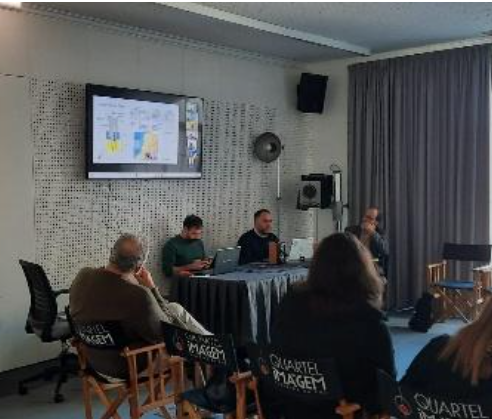
PORTUGAL - The 6th meeting of the PilotSTRATEGY Regional Stakeholders Committee was held on 18 November 2025, both face to face (Quartel da Imagem, Figueira da Foz) and online. These meetings, organised under the PilotSTRATEGY project, aim to update national and local stakeholders in Figueira da Foz, Portugal, on the latest developments in the project.
There were 27 stakeholder representatives present from 18 different organisations. The group included stakeholders operating at national and local levels and represented the public, private and third sectors, as well as universities. Most participants represented organisations that had taken part in previous meetings, but there were also representatives from three new companies with whom the team from the University of Évora had recently been holding discussions.

Ana Delicado (ICS) then presented the results of the event with stakeholders (participatory exhibition) that took place in Figueira da Foz in September, as well as the preliminary results of the second public opinion survey carried out during the summer (for the sample of residents of Figueira da Foz only)
Paulo Mesquita (U. Évora) presented the transportation options for both the pilot phase and the commercial phase. In the pilot phase, trains and boats will be used to transport CO2 from a cement factory to the injection site. The team has carried out calculations regarding the capacity and number of containers needed, the time required to fill the containers, transport them to the port, load them onto the ship, transport them to the site and inject the CO2, estimating cycles of 48 hours.
João Casacão (GALP) presented the Measurement, Monitoring and Verification plan for the pilot phase. He listed the criteria for the water column, seabed, subsurface and the injection well, presented the well design and lithostratigraphic prognosis and the programme for data acquisition, showed the model of plume dispersion evolution after three years of injection and explained the 3D seismic acquisition and baseline acquisition using low-impact methods. He also discussed the monitoring of environmental impacts for detecting underwater leaks, presented the timeline for the monitoring actions, and gave a short presentation on the costs of drilling the injection well and seismic monitoring, explaining that some costs would be reduced in the commercial phase.
During the meeting, the project team presented key results and updates, including transportation costs and timelines, as well as the monitoring of injection. Stakeholders engaged actively, raising highly technical questions. They also offered valuable insights on topics such as transport emissions and current and future regulatory frameworks relevant to the technology, which seems to signal a change in policy regarding CCS.