


When: 21 April 2026
Where: Consejo Superior De Investigaciones Cientificas (CSIC), Brussels, and the European Parliament
The PilotSTRATEGY Final Event, held in Brussels, marked the culmination of five years of collaborative research into geological CO₂ storage across Southern and Eastern Europe. Bringing together scientists, industry representatives, policymakers and other key stakeholders, the event provided a platform to present key project outcomes and to discuss the future role of carbon capture and storage (CCS) in achieving Europe’s climate ambitions and in protecting its economies.

Download final presentation slides | View photo gallery
Towards commercial viability
Organised as a full-day event across two venues, including the European Parliament, the programme combined technical presentations with policy-oriented discussions. The morning sessions focused on the scientific and regional achievements of the project, which has investigated the potential of deep saline aquifers (DSAs) as viable CO₂ storage solutions. Over the course of the project (2021–2026), research teams conducted extensive geo-characterisation, modelling, and risk assessment studies in key industrial regions across France, Spain, Portugal, Greece and Poland.
Regional leads highlighted progress in understanding storage capacity, site feasibility, safety considerations and societal acceptability. These contributions demonstrated how PilotSTRATEGY has helped to reduce uncertainty and risk around CO₂ storage in areas beyond the well-developed North Sea basin. By advancing knowledge and supporting permitting and investment decisions, the project has laid important groundwork for future CCS deployment in underexplored regions.
Project perspectives
The second session broadened the perspective by incorporating insights from two ongoing CCS initiatives and related projects across the region.
Pantelis Vogiatzis, Commercial Lead Prinos CO2 (Greece), reported significant progress made including signed Memoranda of Understanding for 6.12Mtpa CO2 from various emitter types and receiving Southern Europe’s first CO2 storage permit in Q1 2026 for a depleted gas field in the offshore Prinos field, and outlined a pathway towards FID in Q1 2027, with commercial-scale operations for up to 2.8Mtpa CO2 commencing in 2030.
Konstantin Bojinov, Project Head ANRAV CCUS (Bulgaria), highlighted ongoing developments of the project which is centred around the Devyna cement plant, including discussions with national and local regulators, FEED study for the capture unit and dynamic modelling of the onshore storage site. Control over the full value-chain and low transport and storage (T&S) costs make the project one of the most promising in Heidelberg Materials’ portfolio, however national-level legal and regulatory support will be crucial to realising its potential.

With both projects acknowledging the importance of EU funding and support, the exchange underscored the importance of collaboration and knowledge-sharing across Europe, particularly as the EU seeks to scale up CO₂ storage capacity in line with policy frameworks such as the Net Zero Industry Act (NZIA). While significant storage development has historically been concentrated in northern Europe, discussions highlighted both the challenges and opportunities for expanding infrastructure in Southern and Eastern regions.
Communication, collaboration and trust

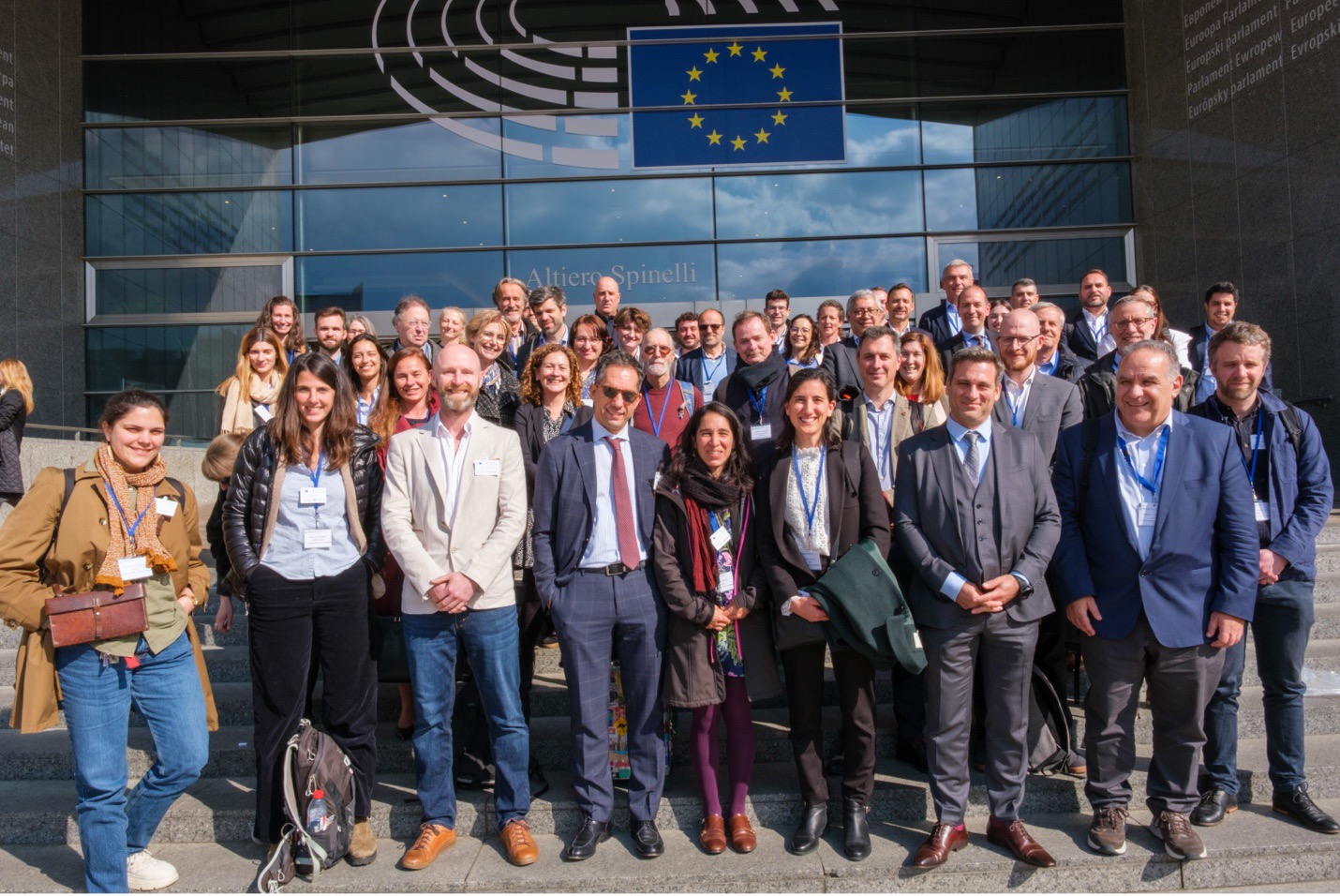
In the afternoon, participants reconvened at the European Parliament for a high-level session focused on policy, impact and future directions. In the session, hosted by Mr Paulo Cunha MEP, presentations summarised the overall outcomes of PilotSTRATEGY across France, Spain and Portugal, including advances in pilot design, safety frameworks and societal engagement. Delivered with passion, the takeaways were very clear:
- The technical basis is largely in place and well-understood.
- Access to storage is increasingly becoming a question of regional fairness and industrial competitiveness within Europe.
- Social and technical feasibility need to move together, not sequentially; engagement is not an add-on.
- The key barriers are now political and regulatory, not geological.
These elements are critical for building public trust and enabling real-world deployment of CCS technologies.

The way forward
A panel discussion entitled “The way forward for CCS in Southern and Eastern Europe” brought together representatives from industry, research organisations and European institutions. The discussion addressed key barriers to implementation, including regulatory complexity, investment needs and public acceptance, while also highlighting the strategic importance of CCS in decarbonising hard-to-abate sectors. The panel emphasised that achieving EU climate targets will require a geographically balanced CO₂ storage network, supported by coordinated policy and sustained innovation.
- T&S costs could decrease significantly under a coordinated European network, rather than relying on isolated regional solutions.
- There is a real risk of a “two-speed Europe” for CCS, if regional differences in regulation, infrastructure and support are not addressed.
- Permitting remains a key bottleneck, often driven by misalignment between national and EU-level processes and resources.
- For industry, particularly cement but also others including refining, chemicals and waste management, CO₂ storage is not optional. Many plants are located far from storage sites, and process emissions cannot be avoided.
- Public perception and communication are still underestimated, despite being critical to deployment.
- Ultimately, CCS will not scale through individual projects alone. It requires coordinated action across policy, industry and society.
The event concluded with reflections on the project’s legacy and its contribution to Europe’s energy transition. By delivering new data, methodologies and stakeholder insights, PilotSTRATEGY has significantly strengthened the evidence base for CCS in regions that have traditionally received less attention.

Overall, the final event not only showcased the project’s achievements but also reinforced a shared commitment to advancing CCS as a key component of Europe’s pathway to climate neutrality and industrial competitiveness.
The PilotSTRATEGY consortium would like to thank the Consejo Superior De Investigaciones Cientificas (CSIC), Brussels, for a warm welcome and hospitality over the full 2 days of this final event and General Assembly mtg., and to Mr Paulo Cunha MEP, and his office, for hosting and joining us at the European Parliament.